What Local Conditions Do
Most of the houses here went up between 1938 and 2002
With the bulk clustered in the 1960s and 70s across 26 named areas in the service territory. That matters because the weatherstripping and bottom seals that came standard on a door built in 1968 were never meant to last fifty-some years, and most of them haven't. Peoria sits in a cold-moderate climate band, so the door that seals fine in October can let drafts rip through by January, especially once the rubber on the bottom seal has hardened and cracked.
Across the roughly 45,146 households in this area
A big share are owner-occupied houses with garages that match the same build era as the main house. That means the same three-sided weatherstrip, the same U-channel bottom seal, and the same brittle vinyl that was fine twenty winters ago. The symptom is the same everywhere: a thin line of daylight along the sides of a closed door, or a draft you can feel standing a few feet back. It's not the door failing. It's the seal around it giving up, and that's a different job entirely than fixing a broken spring or a bent track.
- 45,146 households
The Problem
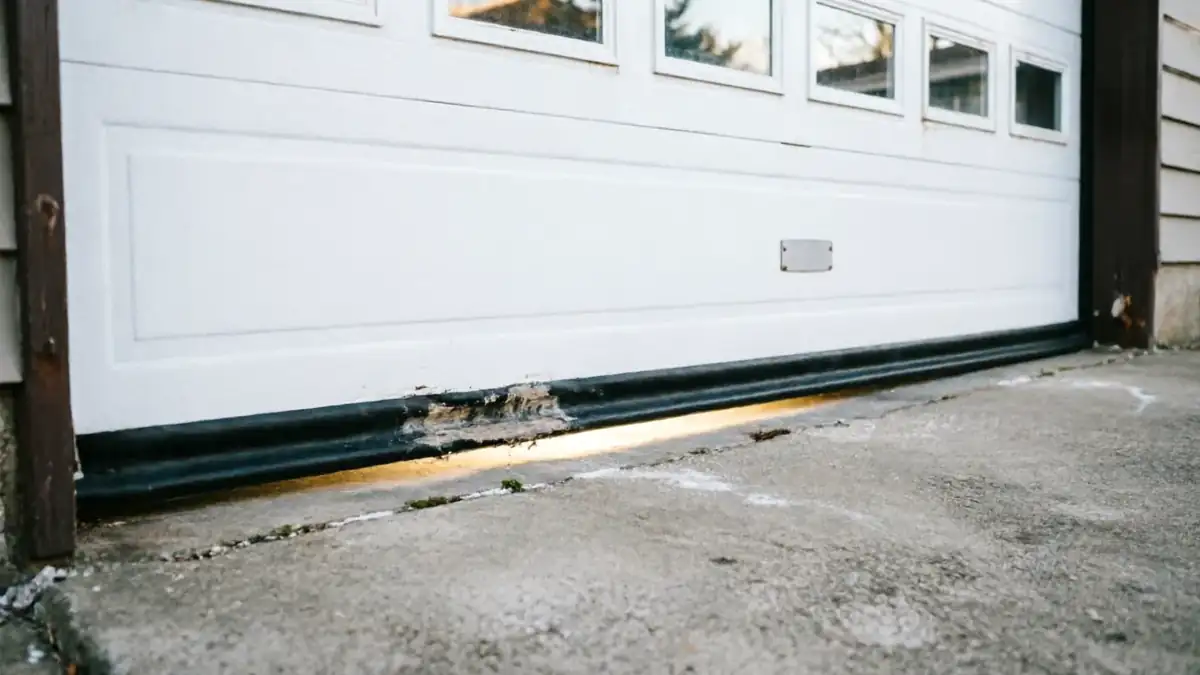
A worn seal doesn't look dramatic. The door still opens, still closes, still looks fine from the driveway. What you notice is a cold floor in the garage, frost forming along the bottom edge on sharp mornings, or a line of dust and grit that's blown in under the door and settled on the concrete. On older doors from the 1960s and 70s stock common in this area, the bottom seal channel itself can be warped or rusted, which means a new seal won't sit flush no matter how well it's installed.
Draughts also show up at the top and sides where the stop molding has shrunk away from the jamb, a common issue on houses built before the newer code-era framing. If your door is original to a house from that mid-century stretch, the seal problem is often compounded by a frame that's shifted slightly over sixty years of freeze-thaw cycles. That's worth knowing before you pay for a seal replacement expecting it to fix a draft that's actually coming from a gap in the framing, not the rubber.
When to Get Help
Call before the cold really sets in, not after. If you can see daylight along any edge of a closed door, or feel air moving when you stand in front of it, the seal has already failed and waiting through a full winter means more heat loss and more water tracking in during the next thaw. A door that whistles in wind is another sign - that's usually the top seal, not the bottom.
We'll tell you straight if a seal job won't fix what you're dealing with. If the bottom panel itself is rusted through or the track has pulled away from the jamb, no amount of new weatherstripping solves that, and we won't sell you a seal kit knowing it won't hold. That's the honest limit of what a seal replacement does: it stops air movement through gaps that are still true and square. It doesn't straighten a warped panel or fix a frame that's racked out of plumb.
What It Costs
We don't post a flat number here because the right fix depends on what's actually failing
The bottom astragal seal, the side and top weatherstrip, or the stop molding itself, and whether the channel it sits in is still straight. A seal-only job on a door that's otherwise sound is a different scope than one where the frame needs attention first.
With a median household income of $71,763 in this area
Most owners we talk to choose to seal and weatherstrip rather than replace the door outright when the panel and hardware are still good. That's usually the more sensible call on a door that's mechanically fine and just leaking air. We'll look at the actual gap, check the track and jamb, and give you a number based on what's in front of us, not a guess over the phone.
- $71,763 median household income